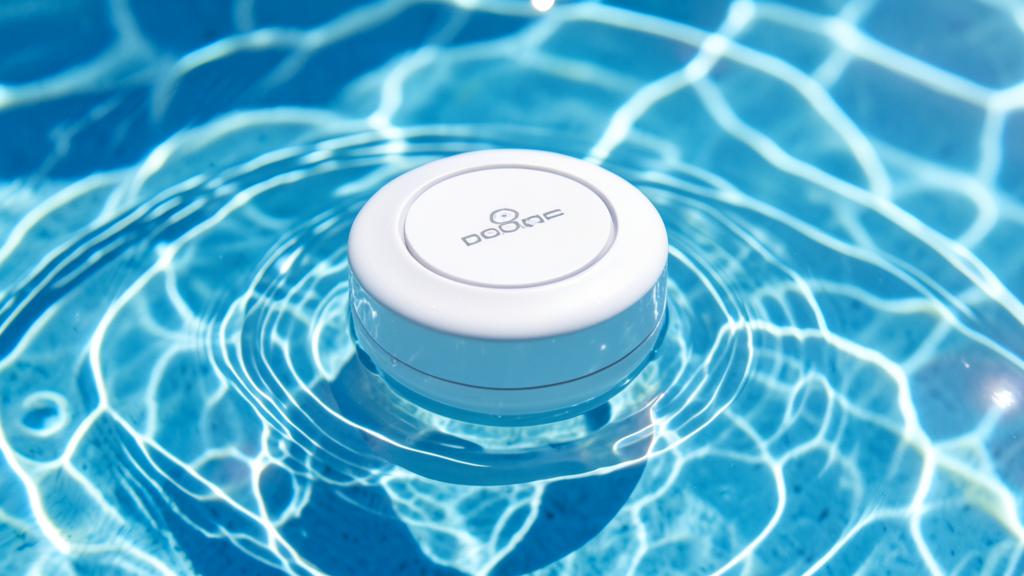
What is ORP and why does it matter more than chlorine levels alone?
Chlorine is the standard measure of pool safety. But ORP — oxidation-reduction potential — tells you something chlorine levels alone cannot. Here is a plain-English explanation of what it measures and why it matters.
The problem with measuring chlorine concentration
When you test a pool for chlorine, you are measuring how much chlorine is present in the water — expressed in parts per million (ppm). The standard target range is 1.0 to 3.0 ppm for a residential pool.
The limitation of this measurement is that it tells you quantity, not effectiveness. Chlorine in water exists in different chemical forms, some of which are active disinfectants and some of which are not. The proportion in each form depends primarily on pH. At high pH, most of your chlorine is in a largely inactive form — present in the water, measurable on a test, but not doing much to protect swimmers.
A pool can test within normal chlorine range and still fail to disinfect properly. This is not a theoretical concern — it is a common real-world situation, particularly in pools where pH is not tightly controlled.
What ORP measures instead
ORP stands for oxidation-reduction potential. Rather than counting how many chlorine molecules are in the water, ORP measures the water's actual capacity to oxidise and destroy contaminants. It is a direct measure of disinfecting activity, expressed in millivolts (mV).
A reading above 650 mV indicates that the water has sufficient oxidising capacity to effectively neutralise bacteria and pathogens. Below 600 mV, disinfection is compromised regardless of what the free chlorine reading says. The World Health Organisation and most public health bodies use ORP alongside chlorine as a dual indicator of pool water safety.
Why ORP is particularly useful for automated monitoring
For a sensor continuously monitoring a pool, ORP is a more actionable measurement than free chlorine concentration. Measuring free chlorine with a sensor in real time is technically complex — the most reliable methods require reagents that need replacing. ORP, by contrast, can be measured reliably and continuously with a simple electrode, with no consumables required beyond periodic probe calibration.
An ORP sensor combined with a pH sensor gives you everything you need to assess water safety in real time: pH tells you whether your chlorine is likely to be in its active form, and ORP confirms whether the water is actually disinfecting effectively.
What normal readings look like
For a well-maintained residential pool:
- pH: 7.2 to 7.6
- ORP: 650 to 800 mV
- Free chlorine: 1.0 to 3.0 ppm
If ORP is below 650 mV and pH is above 7.6, the most likely explanation is that pH needs correcting rather than adding more chlorine — adding chlorine to high-pH water is largely ineffective and wasteful.
Senzo's pool monitoring sensor measures both pH and ORP continuously, giving a real-time picture of actual water safety rather than just chemical quantity. When either reading drifts out of range, an alert fires to the property owner and their maintenance company — before the problem becomes visible to the naked eye.
More in Pool Monitoring
3 July 2026·Pool Monitoring
Green pool syndrome: causes, costs, and how to prevent it
A green pool is not just an eyesore. For a remotely managed holiday villa, it can mean lost bookings, difficult conversations with guests, and an emergency callout bill. Here is what causes it and how to stop it happening.
19 July 2026·Pool Monitoring
pH and chlorine in Spanish pools: what the numbers actually mean
Most pool owners know they need to test the water regularly, but fewer understand what the readings actually tell them — or why pH matters as much as chlorine. A plain-English explanation.
4 August 2026·Pool Monitoring
How often should a pool be tested? The case for continuous monitoring
Weekly testing is the standard for most managed pools. But a lot can change in seven days — particularly in the heat of a Spanish summer. Here is why the interval matters, and what continuous monitoring changes.